
How does one even begin to speak about poverty? As we live in a world where merit is celebrated and those who have inherent social, economic, or cultural capital are rewarded for their personal successes, it is very easy for others to see poverty as an individual’s personal failure—an effect, rather than a cause. But poverty is not always an individual failure, rather a failure of a system whose job is to ensure a livable and dignified life for all.
Poverty As a Violation of Human Rights
One of the most popular poverty alleviation quotes was Nelson Mandela’s:
“Overcoming poverty is not a gesture of charity, it is an act of justice.”
It is more than just a quote, but a reminder that extreme poverty is not only a systemic problem, but a violation of human rights. On October 17, 1987, thousands of people gathered in Trocadéro, Paris, to honor the victims of poverty, violence, and hunger. Since then, October 17th marks the International Day for the Eradication of Poverty, and it reminds us how individual successes and failures are not without systemic successes and failures.
As you read this article, you will find out what efforts are being made right now to alleviate poverty across nations and 9 tried-and-tested strategies nations could adopt for poverty alleviation.
Worldwide Poverty Alleviation Policies and Projects
Poverty happens anywhere around the world, but the majority of the world’s extreme poor live in rural sub-Saharan Africa. What used to consist of only 10% of the world’s population rose to 53% in 2023 World Bank data. Moreover, African cities were also considerably poor, consisting 18.4%. With these numbers, it is important to note that despite holding much of the world’s poorest population, they only represent 1 in 10 people around the world.
Many factors contribute to extreme poverty. Colonialism, for instance, was designed to extract wealth from other countries for the colonizing nation to advance its own economy. Feudalism has created a top-down system where peasant workers were consistently exploited by the landlords. The ever-present competitive system of capitalism continuously prioritizes profit over human needs. Not everyone can win in a capitalistic society. Someone, somewhere, will take the brunt or the losing end of this centuries-old game. Poverty is without its many dimensions, and these are only a few instances that could point to why it is not merely an individual failure in people’s lives.
There have been efforts to reduce extreme poverty, and these efforts are as follows:
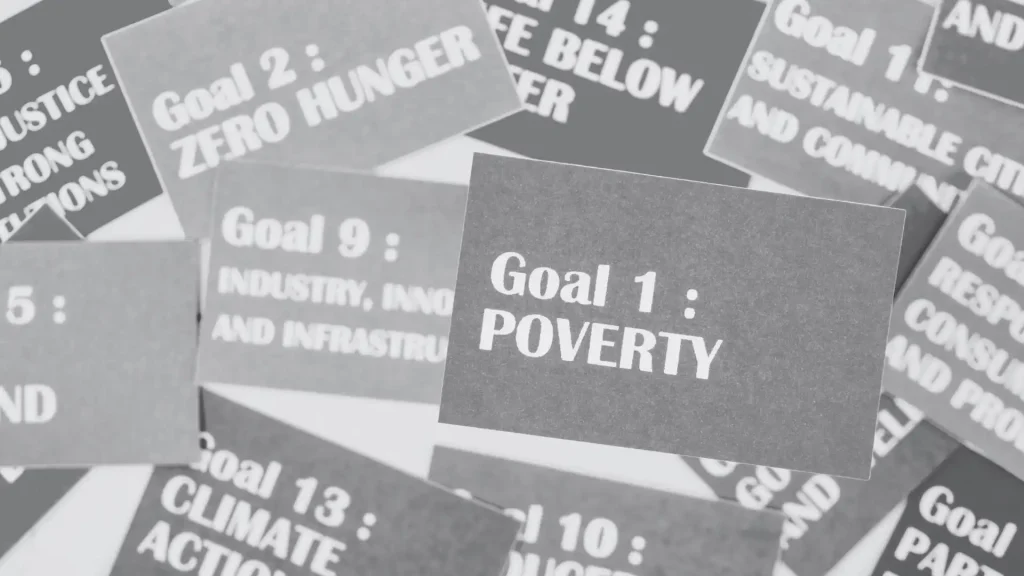
UN SDG 1
The United Nations’ first Sustainable Development Goal is “No Poverty” by the year 2030. The main goal is to reduce poverty by at least half through implementing social protection systems, ensuring equal access to basic services and economic resources, and building resilience against natural calamities and disasters.
In 2022, the World Bank defined extreme poverty as individuals living on less than USD 3 per person each day, making the numbers jump from 713 million to 838 million.
The Graduation Approach
The Graduation Approach has many names, including “Cash Plus Programming” or “Productive Inclusion,” but they are all the same. It targets the people in extreme poverty by providing a holistic approach to reducing poverty. They do this through cash transfers, transfer of productive assets, technical training to properly operate on that particular asset, and coaching and mentoring.
The Graduation Approach is similar to our microfinancing projects and livelihood training programs at Captivating International. Our current work helps women in Nepal, the Philippines, and China to achieve financial independence through entrepreneurship.
Global Alliance Against Hunger and Poverty
The Global Alliance Against Hunger and Poverty focuses on the elimination of SDGs 1 and 2: No Poverty and Zero Hunger by the year 2030. It helps align like-minded national and international projects that need financial, technical, and knowledge support to implement large-scale policies. It was launched in November 2024.
World Bank Upstream Support
World Bank Upstream Support is an initiative led by the International Finance Corporation. It proactively creates, deepens, and expand markets to help the private sector invest in projects involved in Low-Income Countries and Fragile and Conflict-affected Situations. Other initiatives focus on Upstream Support (financing and technical support to existing projects); this one focuses on Downstream Support (initiates the projects before they are even visible to the public)
How to Alleviate Poverty
Different nations have different gaps to fill, but wherever that country of origin we speak of, there will always be tried and tested ways to alleviate poverty.
1. Make education accessible
Education is not only the “key to success” in a merit-based society, but it is also an effective way to free one’s mind, allows them to make educated decisions for themselves, and lets them participate in society in a truly present manner. Study showed that if everyone completed at least secondary education, poverty around the world could be reduced by 50%. If a person has enough education, they are more likely to find better employment opportunities and less they are to be taken advantage of.
2. Empower women
People in developed nations know that women are just as capable as men; they are not just given enough representation in certain fields. But the important nuance here is that there is a lot of unpaid labor that women do: managing households, caregiving, homemaking, etc. In many cultures, these expectations are almost automatic, but the lack of acknowledgement and default positioning of women into these kinds of roles further hurt them and their families.
For example, when the family patriarch is sick, injured, and unable to work—it is the woman who needs to step up into a moneymaking role. Because the mother cannot work due to a lack of skills, their daughters may be married off, or their sons may be forced to drop out of school. This easily pushes the following generations of the family into a vicious cycle of poverty.
When nations empower women, they are given the opportunity to participate in the economy. Younger girls could see what is possible for them,
3. Increase access to clean water and sanitation
1 in 4 people do not have access to safe drinking water. Although one of the most basic human necessities, people in many parts of the world have trouble accessing clean water. Some need to go out and walk for miles just to fetch a pail of water to bring to their families.
When families cannot access clean water, they are more likely to be sick from lack of hydration or from water-borne diseases. It is in these communities where medical services are not easily accessible, leading to serious illnesses and fatalities.
4. Make healthcare accessible
Every year, 100 million people are pushed into poverty due to health expenses. Poor families do not typically seek medical attention until the case is already severe. These illnesses might hinder them from working and supporting their families, and many times, could easily push them into debt that trickles down to their children and grandchildren.
In some areas, there are no known health centers or community doctors to help when in need. And sometimes, public hospitals are full and cannot accommodate all patients. When there is accessible and affordable healthcare, the poor can have an extra cushion to fall back on when they get sick.
5. Improve food security and nutrition
Eliminating malnutrition is known to be the most cost-effective way to alleviate poverty. In many parts of the world, food is scarce, hence leaving children vulnerable to different forms of illnesses, stunting their development, and prohibiting them from fully participating and being present in school and society as a whole.
Many factors could contribute to a lack of food security and nutrition. Some places are naturally scarce due to their geographical location. Like the lack of clean water, some food is not transported to certain places. In many cases, malnutrition could also be present not because of a lack of food security, but because of only having access to ultra-processed food.
6. Invest in affordable housing
Governments investing in affordable housing can help alleviate poverty by reducing the anxiety of individuals regarding healthcare, food, security, education, etc. All of these factors are interconnected. Once people’s basic needs are covered, and they are not trapped in survival mode, they can focus on improving their lives. Children who also grew up in stable homes and do not need to move a lot tend to focus on their education better.
7. Invest in disaster risk reduction
Natural and man-made disasters can be families’ greatest tragedies. Despite how much they invest in their future, an onslaught of a fire, storm, or hurricane could easily bring them back to square one. Investing in disaster risk reduction can increase by 4.4 times, according to a study in the International Journal of Risk Reduction. Countries like the Philippines and Nepal are especially vulnerable to the effects of global warming—often victimizing hundreds and thousands of families every year.
8. Stronger union representation
Unions, by nature, help turn low-paying jobs into “decent work”. Meaning, the working class is not merely exploited for their labor, rather given the opportunity to live decent and dignified lives. In helping achieve stronger union representation, families could afford their basic needs, send their children to school, and have extra disposable income when emergencies arise. Union representatives push for employment benefits such as health insurance, retirement plans, and paid leave.

There is no one solution that could magically stop poverty in nations forever. It takes a holistic approach to understand the needs of every community. Often, it must target the most basic human needs and then move toward providing education and livelihood opportunities. While there are anti-poverty projects in place, governments still hold a lot of power in enacting policies for the improvement of the quality of life of its people.
To help, one could support local advocacy groups and/or nonprofit organizations. If you want to help alleviate poverty today, you may do one act for endless impact by donating today.
DID YOU KNOW?

How To Protect Your Children Against Predators (आफ्ना बच्चाहरूलाई शिकारीहरूबाट कसरी जोगाउने)
अनलाइन यौन दुर्व्यवहार के हो भन्नेबारे जान्नुहोस् र आफ्ना बालबालिकालाई अनलाइन शोषण तथा…
0 Comments6 Minutes
Online Sexual Abuse Red Flags (अनलाइन यौन दुर्व्यवहार रातो झण्डा)
अनलाइन ग्रुमिङका चेतावनी संकेतहरू, देखिन सक्ने सामान्य संकेतहरू, र आफ्नो बच्चालाई अनलाइन…
0 Comments7 Minutes

Ligtas ba ang Anak Mo Online? Mga Senyales na Kailangang Bigyang-Pansin
Alamin kung paano makikilala at maunawaan ng mga magulang ang grooming at mapoprotektahan…
0 Comments13 Minutes

How To Make Children Feel Safe and Heard In Times of Emergency
Learn how to build trust with your children through open communication, empathy, active…
0 Comments4 Minutes
Australian Charities to Donate To Depending On Your Advocacy
Australian charities to donate to across health, food security, education, human…
0 Comments9 Minutes

How Less Screen Time Doesn’t Mean Less Risk From OSAEC
Reducing screen time isn't enough. Learn the offline factors that increase children's…
0 Comments4 Minutes
Online Sexual Abuse Red Flags
Learn the warning signs of online grooming, common red flags, and practical tips to help…
0 Comments8 Minutes
How To Protect Your Children Against Predators
Learn what online sexual abuse is and discover practical tips to help protect your…
0 Comments7 Minutes

How Can We Achieve Quality Education Across Nations?
Quality education is key to reducing poverty. This article explores global education gaps…
0 Comments8 Minutes